Product tour
See every step a governed agent change goes through
The real product, in the order you would build it: the models it routes through, the schemas that guard each handoff, the pipeline graph, the human gate, the agent dispatch, and the record it leaves behind. Self-hosted - the same software you run yourself.
Every screenshot on this page is a capture of a live Modulo instance.
Step 1
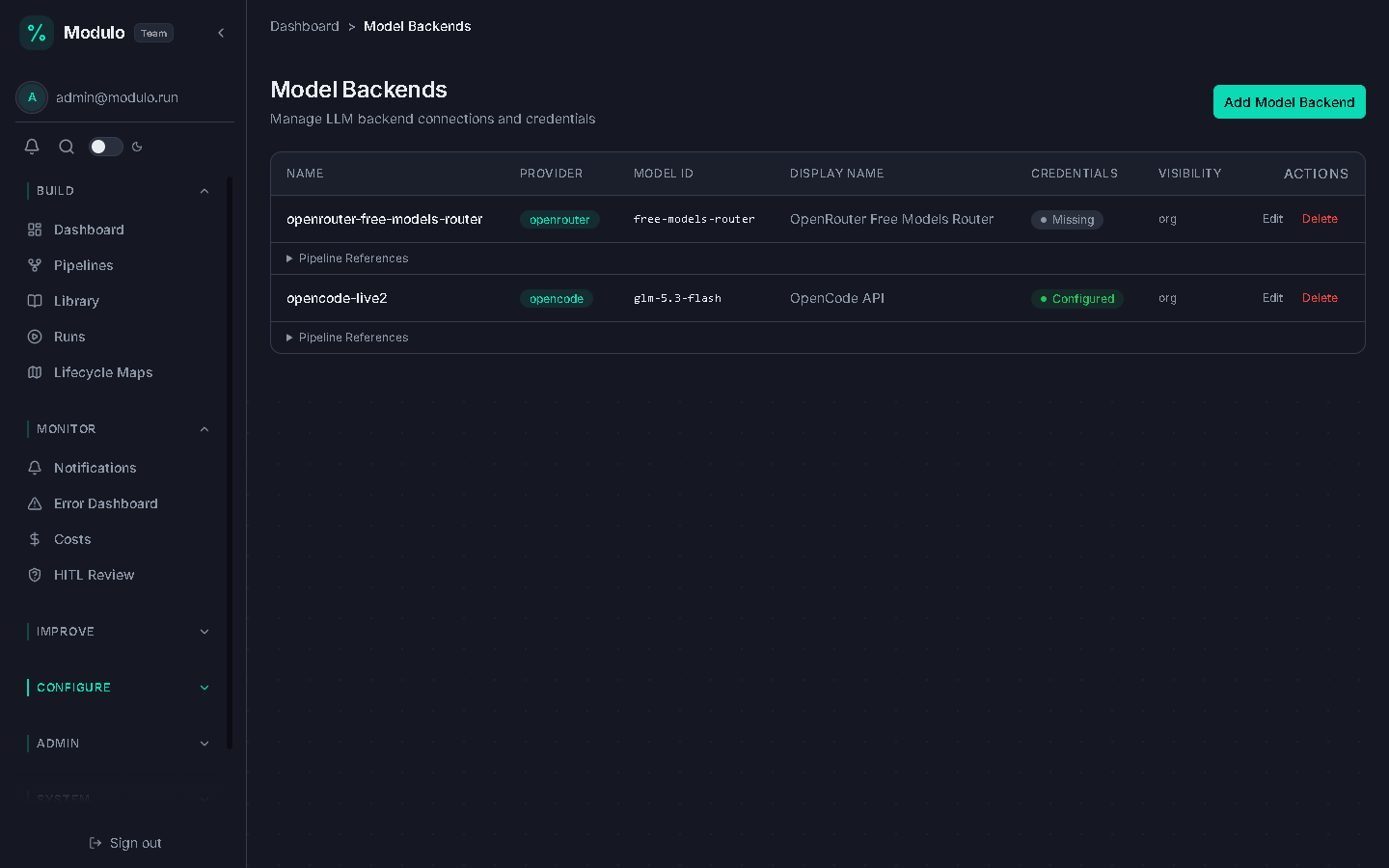
Connect the models you already use
Register a model backend - Anthropic, OpenAI, or any OpenAI-compatible endpoint such as Ollama or vLLM. Modulo health-checks each backend and routes around a failed provider, and individual nodes choose the backend they run on.
Step 2
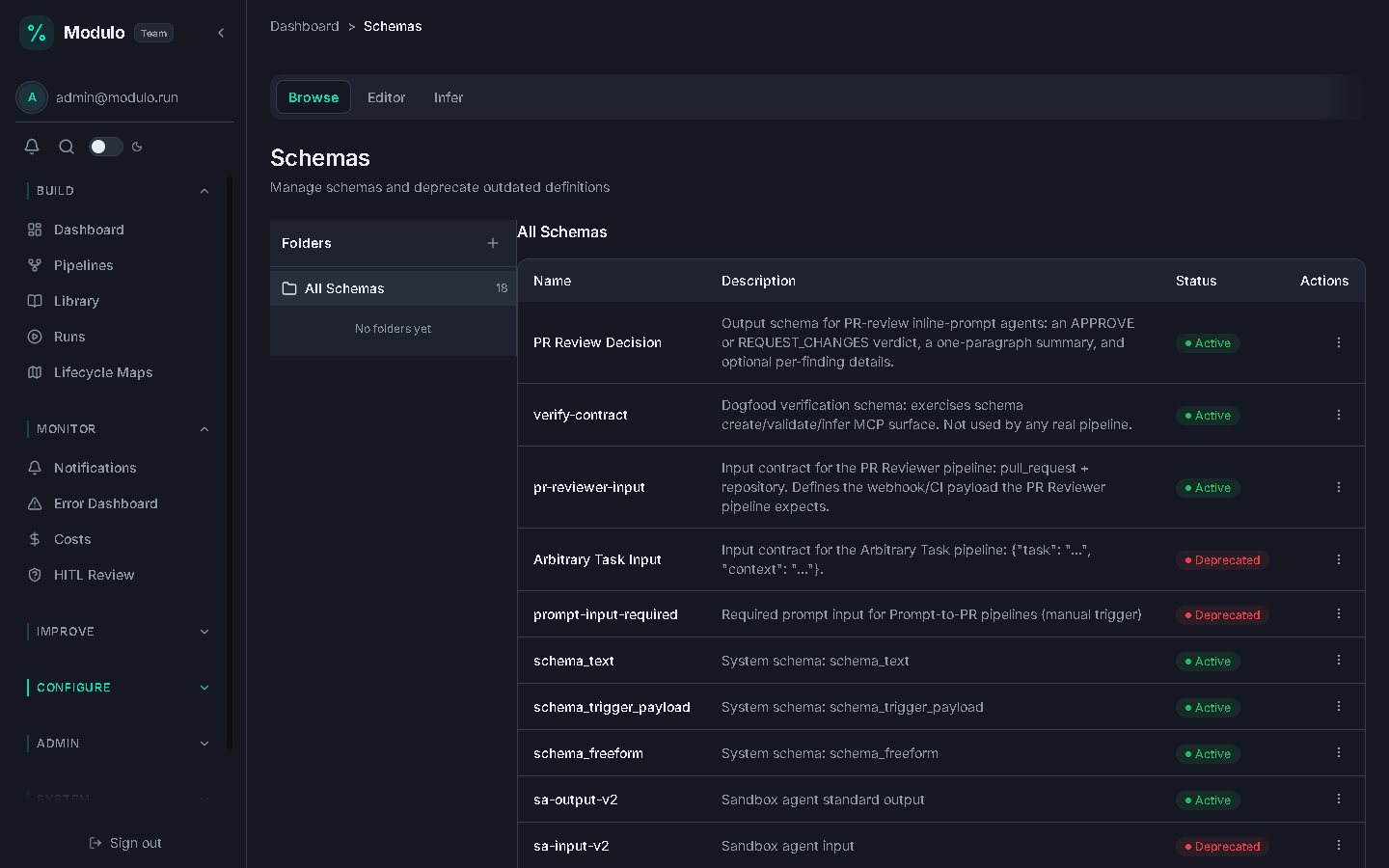
Define the shape of every handoff
Bind a versioned schema to each node's input and output. A step whose output does not match its schema fails before the next node runs, so a malformed agent response never reaches the tool behind it. A schema change creates a new version and leaves the old one in place.
Step 3
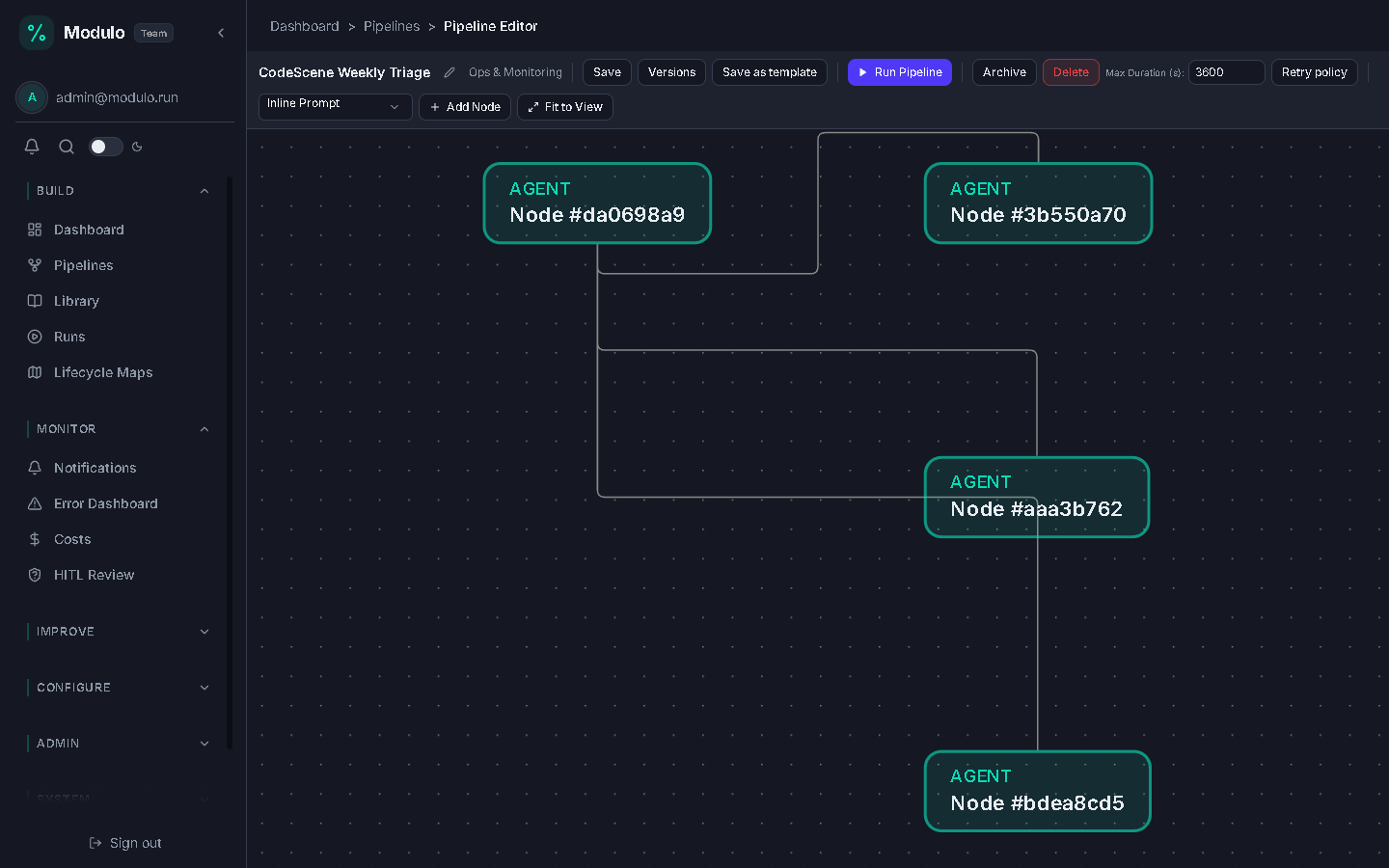
Compose the pipeline as a graph
Place agents, connectors, gates, and human steps as nodes on a canvas and connect them with edges. The editor validates the graph before it saves - missing bindings, incompatible schemas, and unreachable nodes are rejected there, not at run time.
Step 4
Put a human where the risk is
Mark a step human-only and the run pauses in Awaiting Human. A reviewer claims the gate, reads the run context and the upstream output, and approves or rejects. The decision, the reviewer, and the timestamp are recorded.
Step 5
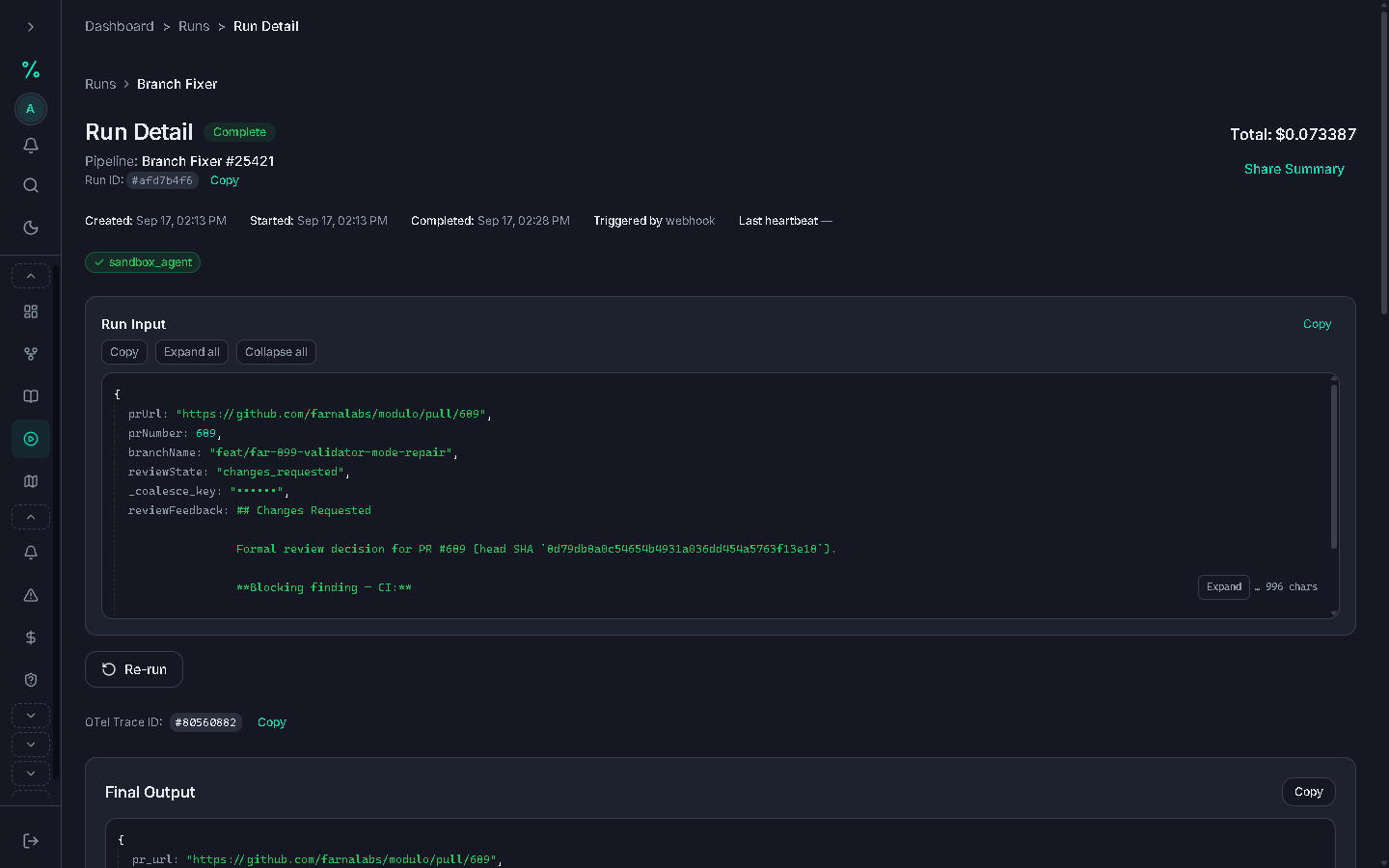
Dispatch the agents you already run
Modulo does not supply agents. It dispatches work to the runtime you already use - Claude Code, Cursor, Copilot, or your own harness - and writes the prompt, output, cost, and exit status to the run record.
Step 6
Prove what happened
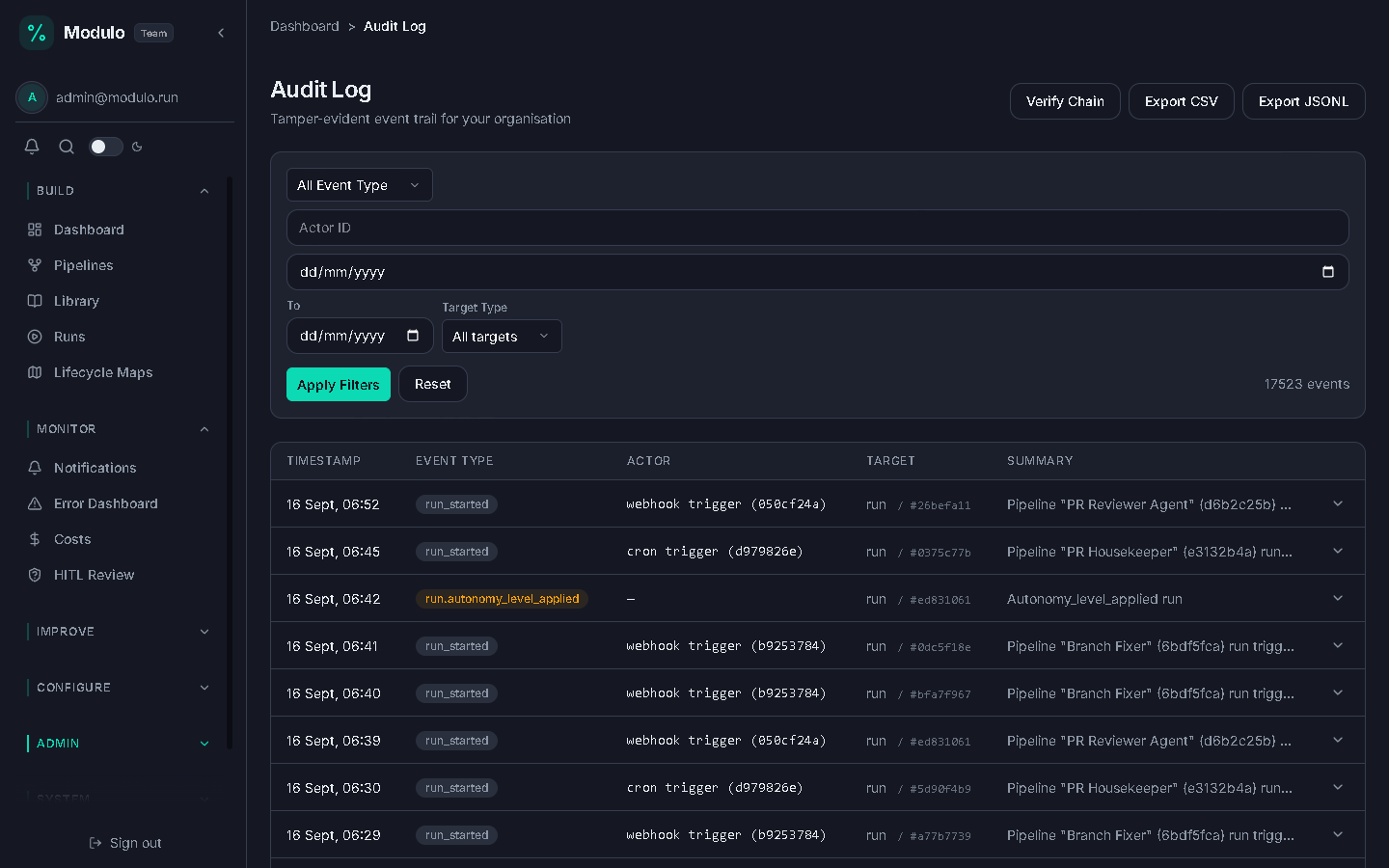
Every governance event - run start, agent dispatch, human decision, gate outcome - lands in a hash-chained, append-only audit log inside your instance, next to the full captured output of each agent run. Verify the chain, or export it for an audit.
Run it yourself
Modulo is self-hosted software. Clone it, bring your own models and agents, and keep every prompt and every record inside your own network. There is no hosted trial.